Wolf · wall oven
Wolf Wall Oven Running Cold or Locked Shut
Built into a cabinet with no easy way out, which is why the diagnosis has to be right the first time.
What owners describe
- Oven is not heating at all, though the panel still lights up
- Oven stopped heating after a self-clean cycle
- Oven runs twenty or thirty degrees cold
- Display is dark but the oven still heats
- Oven stays locked after a self-clean cycle
- Convection fan runs constantly, even when off
- Door will not close flush along the top edge
- Broil element glows only at one end
- Preheat takes far longer than it used to
- Cooling fan keeps running long after the oven is off
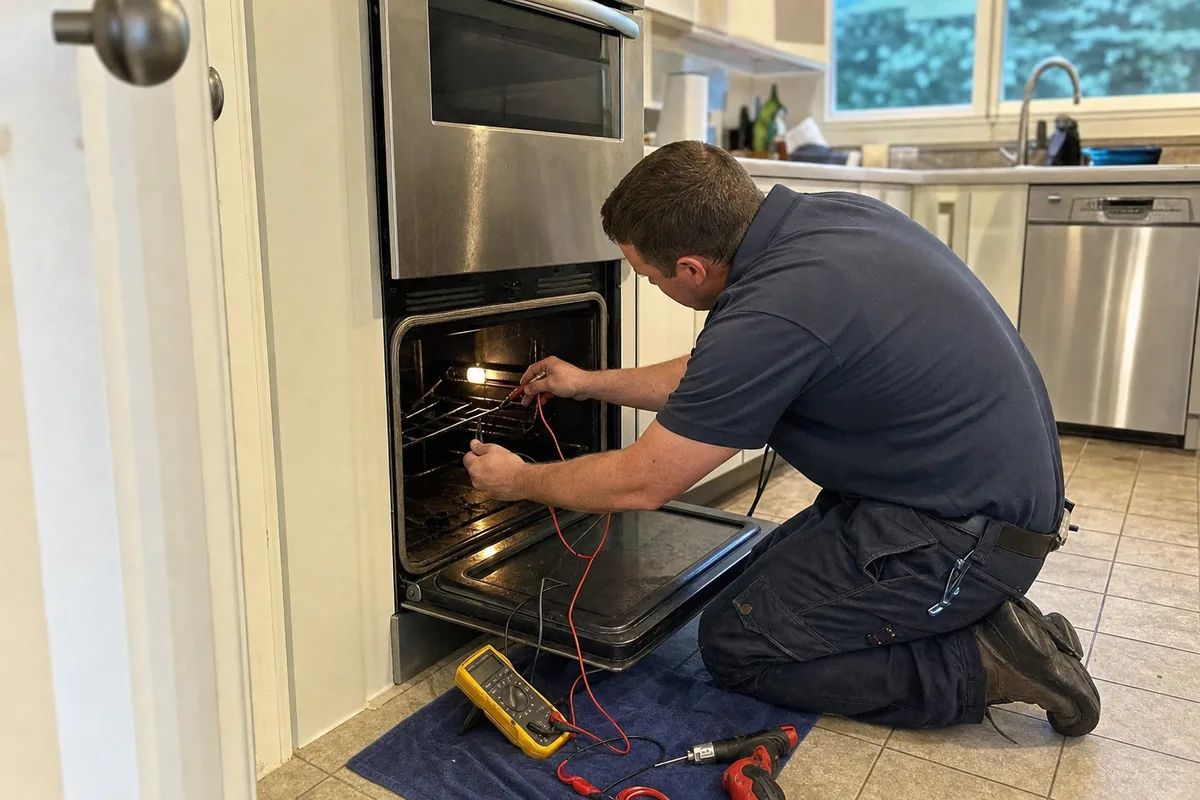
A wall oven lives inside a cabinet, and that fact drives everything about servicing one. It is heavy, it is captive, and pulling it out is a two-person job that often means removing trim and sometimes a drawer above or below. So the diagnosis has to be finished before the oven moves, not after. Most of what we do on a first visit is testing at the connector block and at the door, in place, and only committing to the pull when we know what is coming out with us.
Running cold without a fault
The single most common wall oven complaint is not a failure at all, in the sense that nothing on the appliance reports a problem. The oven simply is not the temperature on the dial. Bread browns unevenly, roasts run long, and the owner has been adding fifteen minutes to everything for a year.
That is almost always the temperature probe. It is a resistance sensor: cold, it sits at a known value, and it climbs predictably as the cavity heats. When the element ages the resistance curve shifts, the board reads a higher temperature than the oven has, and it stops calling for heat early. The oven holds a perfectly stable temperature — just the wrong one. We measure the probe cold, measure the cavity with an independent thermocouple hot, and the gap tells the story in about ten minutes.
The second cause is a door that no longer seals. Heat leaving the top of the cavity means the element cycles more often to hold setpoint, and on a cavity with a marginal probe the two faults compound.
Self-clean and what it costs
Pyrolytic self-clean takes the cavity far above normal cooking temperature and holds it there for hours. Everything in the appliance experiences that: the door latch motor, the thermal cut-out, the hinge springs, the wiring loom behind the liner, and the control board sitting above the cavity in still air.
A large share of the wall ovens we see for a dead display or a stuck lock were last used for a self-clean cycle. That is not an argument against ever running it, but it is an argument for running it on a cool morning with the kitchen ventilated, with the racks out, and not the night before a holiday. If the door will not release after a cycle, the usual sequence is: let it cool fully, cut power at the breaker for a few minutes, restore it, and see whether the latch resets. If it does not, the latch motor or its switch is the part, and forcing the door bends the frame.
Dead display, working heat
Wall oven controls are frequently split between a user interface board behind the panel and a relay board doing the switching. When the display goes dark but the oven still responds — or the reverse — the split is doing you a favour, because it narrows the fault to one of the two. We do not replace both.
Jacksonville’s roughly 68 thunderstorm days a year show up here more than anywhere else in the kitchen. A wall oven that came back from a storm with a dark panel and an audible relay click has a supply-side problem to rule out first: one leg of a 240-volt circuit lost at the panel produces exactly that symptom, and it is not an appliance fault at all.
Doors, hinges and glass
A wall oven door is a stack of glass panes with an air gap, hung on spring hinges that carry real weight. Over years the springs relax and the door starts to sit proud along the top. You can often see it: a line of light at the corner with the oven on, or discoloured cabinet trim above the door where hot air has been washing across it.
Hinges are replaced in pairs. A single new hinge next to a tired one puts the door out of square and works the new spring twice as hard.
Double ovens
On a double wall oven the two cavities usually share a control and a cooling fan but have their own elements and probes. When only the lower cavity misbehaves the shared parts are almost certainly fine, and saying so early saves you the price of a control board.
What the visit looks like
Flat $80 diagnostic, credited toward the repair, written estimate before any part is ordered, genuine OEM parts. Bring us the model and serial from the plate — on a wall oven it is normally on the frame behind the door, at the left or right jamb — and we can usually tell you before we arrive whether the part is on the van.
$80 flat diagnostic, credited toward the repair when you go ahead with it. +1 (904) 867-2707 Full terms · Warranty · Questions
What it costs
What do repairs to Wolf wall ovens cost in Jacksonville?
The visit itself is a flat $80. That buys the trip and the whole diagnostic sequence, and it comes off the total the moment you approve the work. What the work runs to on equipment of this class is below.
| What gets replaced | Parts and labour |
|---|---|
| Oven thermostat or temperature sensor | $190–$530 |
| Convection fan or motor | $250–$680 |
| Control board or touch panel | $460–$1,070 |
| Door hinge, glass or seal | $180–$720 |
Questions
Wall ovens: the questions we get asked
- The oven is not heating at all. Where do you start?
- With the supply, then the probe, then the element, in that order, because the first of the three costs nothing to rule out. A dark panel on a live circuit points at one lost leg of the 240-volt feed rather than at the oven. A panel that lights and never heats is usually the probe reading the cavity hot and cancelling the call for heat before the element ever gets going.
- The oven holds a steady temperature but everything takes longer. What is that?
- Almost always the temperature probe. As the sensor ages its resistance curve shifts, the board reads the cavity hotter than it is, and it stops calling for heat early. We measure the probe cold and the cavity hot with an independent thermocouple, and the gap between them tells the story in about ten minutes.
- The door will not release after a self-clean cycle. What should I try?
- Let it cool fully, cut power at the breaker for a few minutes, restore it, and see whether the latch resets. If it does not, the latch motor or its switch is the part. Do not force the door: that bends the frame and turns one part into several.
- Does one hinge need replacing, or both?
- Both. A single new hinge beside a tired one puts the door out of square and works the new spring twice as hard, so hinges go in pairs. A door sitting proud along the top edge is usually springs relaxed by years of self-clean cycles rather than anything wrong with the cavity itself.
Owner reports
What owners said after wall ovens work
4.3 out of 5 from 81 published reports. Each one is a single visit, in the words of the person who paid for it.
The convection fan carried on running with the oven switched off and nothing would stop it. He found the control had stuck calling for it, changed the board, and stayed until it had cycled properly twice.
Delia S.
The upper oven of the pair had gone dark while the lower one carried on. He found the shared control had lost one output, replaced the board, and set both cavities against a probe before he packed up.
Georgia P.
The cooling fan kept running for an hour after the oven was switched off. He explained it is meant to run on, then measured the cavity and found a thermal cut-out sticking, which held it far longer than it should.
Renata J.