seasonal · August 15, 2026
Storm Season and the Control Board
A dark display and working burners the morning after a storm is a panel check first and a board diagnosis second.
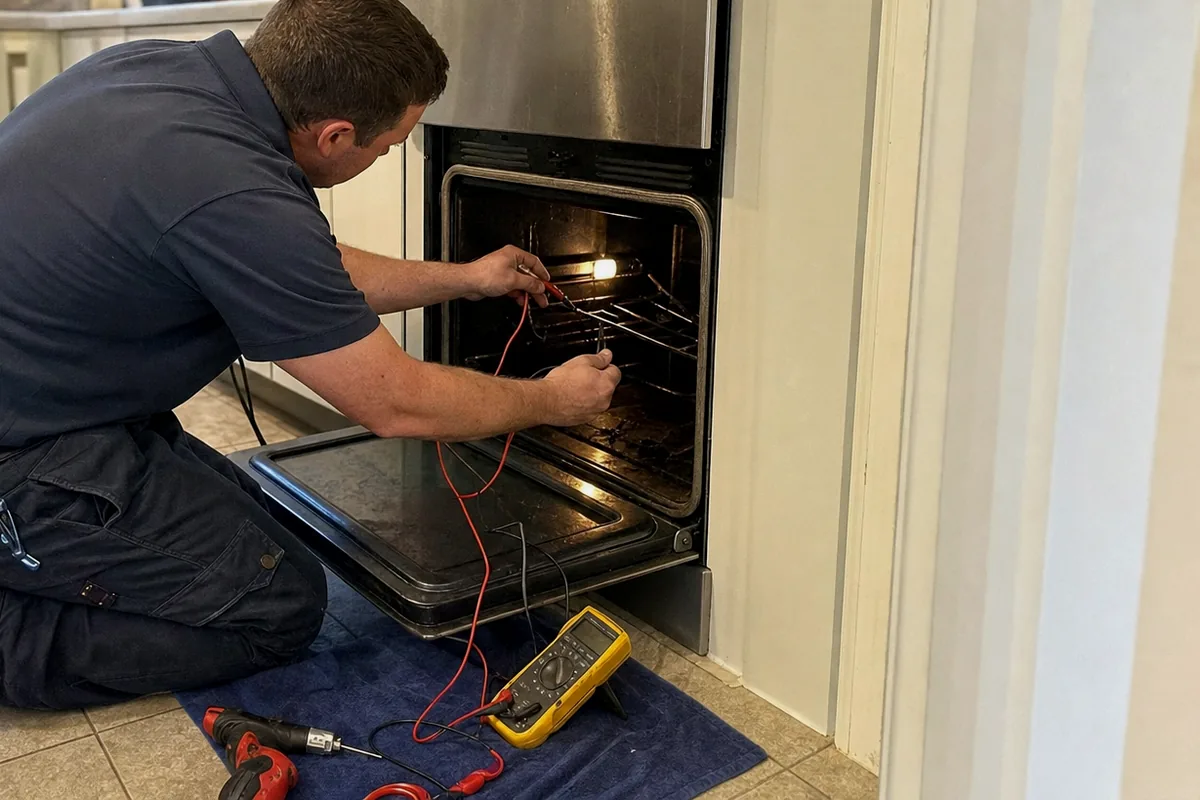
Jacksonville averages somewhere around 68 thunderstorm days a year. From June through September the pattern is close to daily, and every one of those afternoons is a small test of the electronics in your kitchen.
The call we get the next morning is almost always the same sentence: the display is dark but the burners still work.
Do this before you call anybody
Go to the panel and look at the breaker for the appliance.
A range, a wall oven, an induction cooktop and a dual fuel oven all run on 240-volt circuits, which means two hot legs. If one of those legs is lost — a tripped double-pole breaker that has moved only partway, a loose lug, a failed leg upstream — you get a very specific and very misleading result. The appliance is not dead. It is half alive. The 120-volt side keeps working and the 240-volt side does not, or the reverse, depending on how the appliance splits its loads.
That produces exactly the symptom people describe as a failed control board: lights on but no heat, or heat but no display, or a panel that comes up and immediately drops out.
Switch the breaker fully off, wait a moment, switch it fully on. If the appliance returns, nothing inside it was ever broken. We would rather tell you that on the phone than charge you to discover it.
Why boards actually die here
When it is not the supply, the mechanism is worth understanding, because it tells you what to do about it.
A direct lightning strike is dramatic and rare. What is common is everything around a storm: brief outages, voltage sag as load shifts, and reclosures — the distribution system automatically re-energising a line a second or two after a fault, sometimes two or three times in quick succession.
Electronics tolerate one clean loss of power extremely well. They tolerate three interruptions in ninety seconds much less well, because each restoration is an inrush event through a power supply that is still partly charged. Repeated across a summer, that is what ages a board.
This is why the tree-heavy parts of the county see more of it. Old Mandarin along the river and the Ortega peninsula both sit under substantial live oak canopy over the distribution lines, and limbs on conductors produce exactly the interrupt-and-restore pattern that boards hate. The same storm that gives an open-lot house in Bartram Park one clean flicker can give a house under the oaks four.
Surge protection that is worth having
Point-of-use surge strips do nothing for a hardwired appliance, because there is nothing to plug in.
A whole-house surge protective device installed at the panel is the real answer, and it is a modest cost against the price of a control board for a built-in appliance — let alone two or three of them. It will not prevent an outage and it will not protect against a direct strike, but it clamps the transients that do the cumulative damage.
If your kitchen has a dual fuel range, a wall oven, a steam oven and an induction cooktop in it, the arithmetic is not close.
What to do during the season
If a storm is genuinely overhead and you are not cooking, there is no harm in switching the kitchen breakers off. Most people will not do this, and that is fine — it matters far less than the panel-level protection does.
After an extended outage, bring appliances back one at a time rather than restoring everything at once. It costs nothing and it reduces the inrush each one sees.
And do not run a self-clean cycle on a stormy afternoon. Pyrolytic cleaning puts the cavity and everything around it under the heaviest thermal load the appliance ever experiences, and interrupting it partway leaves a door locked on a hot cavity with a control that may not have survived the interruption. Run it on a clear morning.
When it really is the board
Sometimes it is. The tell is usually that the fault does not change with a power cycle and does not change with the breaker: a display with missing segments, a relay that clicks but never closes, an appliance that comes up and resets on a fixed interval regardless of what you ask it to do.
We test at the connector block before we commit to a board, because a board is the most expensive single part in most of these appliances and the one most often replaced unnecessarily. You get the measurement and the part number in writing before anything is ordered.
$80 flat diagnostic, credited toward the repair when you go ahead with it. +1 (904) 867-2707
What it costs
What does this kind of seasonal failure cost to repair?
The visit itself is a flat $80. That buys the trip and the whole diagnostic sequence, and it comes off the total the moment you approve the work. What the work runs to on equipment of this class is below.
| What gets replaced | Parts and labour |
|---|---|
| Control board or touch panel | $460–$1,070 |
| Convection fan or motor | $250–$680 |
| Oven thermostat or temperature sensor | $190–$530 |
Questions
Asked about this note
- What should I check before calling anyone after a storm?
- The panel. A dark display with working burners, or a half-dead cooktop, is very often one lost leg of a 240-volt circuit rather than an appliance fault at all. Reset the breaker fully, off then on, and give the appliance a minute to come back before deciding the board has gone.
- Why do boards fail weeks after the storm rather than during it?
- Because a surge can damage a board without stopping it. The appliance comes back on, works for a while, and fails later with nothing obvious to connect it to. When we ask what the power has been doing over the last month or two, that gap is what we are asking about.