Wolf · rangetop
Wolf Rangetop Igniter Clicks but Will Not Light
The drop-in gas top with no oven under it, where nearly every fault is ignition, sealing or a blocked port.
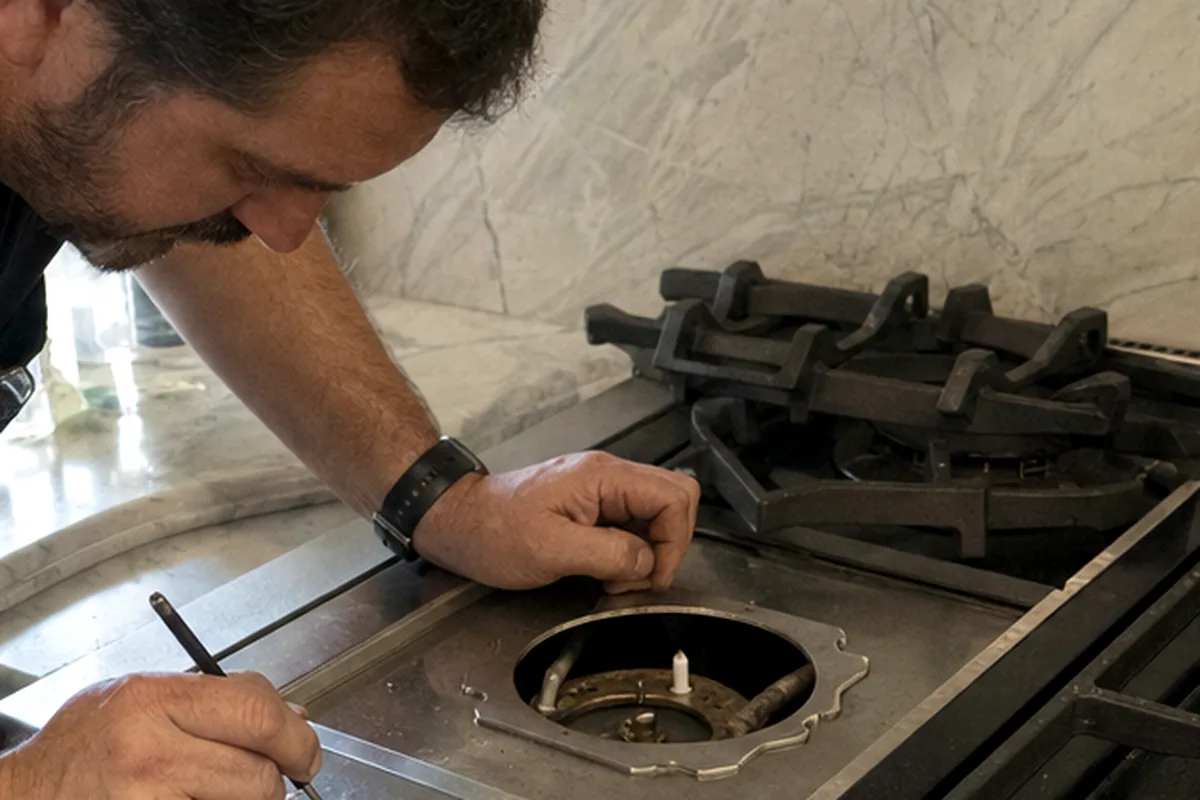
What owners describe
- One burner clicks steadily but never lights
- All igniters click when only one knob is turned
- Flame is yellow and lifting off the burner head
- Lowest simmer setting is no longer a simmer
- Griddle heats hot in the middle and cold at the edges
- Char-broiler takes a long time to come up
- Faint gas smell when the knob is first turned
- Knob turns but feels loose or gritty
A rangetop is a gas cooking surface that drops into the counter with cabinetry underneath rather than an oven. That single difference changes the service picture completely. There is no self-clean cycle cooking the wiring from below, no oven cavity to trap heat, and no electric side at all beyond the spark module and the surface light. Almost everything that goes wrong is combustion, ignition or something that boiled over.
Why a burner clicks and will not light
The sequence is short. You turn the knob, a switch tells the spark module to fire, the module sparks at the igniter, gas arrives, and the flame is proved. Break any link and you get the same symptom: clicking, no fire.
The most common break is at the burner head itself. Gas leaves through a ring of small ports, and those ports fill with sugar, oil and the crust of whatever came over the side of a pan. When the ports nearest the igniter are blocked there is no gas where the spark is, so nothing happens even though the burner is perfectly healthy. The second most common cause is a cap that has been lifted for cleaning and set back down a few degrees out of register. The cap and the head are keyed for a reason.
Only after those two do we start looking at the igniter, the module and the valve switch. Replacing an igniter on a rangetop whose ports are packed is the classic wasted part.
All the igniters clicking at once
Every spark module on a multi-burner top fires all igniters together — that is normal on ignition and it should stop as soon as the flame is proved. What is not normal is continuous clicking after the burner is alight, or clicking with every knob off.
In Jacksonville the usual cause is water. Humidity here sits high enough for long enough that a cooktop wiped with a wet cloth can carry a conductive film across a ceramic igniter base for a surprisingly long time. Leave the burners off and the surface dry for a couple of hours and the clicking often stops on its own. If it does not, the fault is a cracked igniter, a switch that is not returning, or a module that has failed closed — and those need a meter, not patience.
Lost simmer, yellow flame, lifting flame
The three flame complaints are different problems and are worth separating.
A lost simmer means the lowest setting no longer holds a gentle flame. On a sealed burner this is usually the valve’s low-fire adjustment or a partially obstructed simmer port, not a supply pressure problem. It creeps in slowly. Most owners tell us they have been compensating with a diffuser for a year.
A yellow, lazy flame means the burner is not getting enough primary air. Blue with a soft yellow tip is normal on some burners; a flame that is yellow through its body and leaves soot on the bottom of a pan is not. Air shutters drift, and grease films close them.
A flame that lifts off the head — blowing away from the metal, roaring — is the opposite: too much gas or too much air for that port size. It is also the one worth calling about promptly rather than living with.
Griddle and char-broiler modules
Integrated griddles are a thermostatic surface, and the usual complaint is uneven heat. Before condemning the thermostat, check whether the plate is still flat. A griddle plate that has been shocked with cold water while hot can cup by enough to lose contact with its heat spreader, and after that no control adjustment will make the edges match the middle.
Char-broilers are simpler: a burner under a grate and a radiant surface above it. Slow warm-up is nearly always a fouled radiant or a partially blocked burner, and both are cleanable.
Ventilation is part of the appliance
A rangetop is usually the highest-output cooking surface in the house, and it is often installed under a hood that was sized for the last one. If your burners are healthy but the kitchen fills with smoke on the char-broiler, the fault may not be in the rangetop at all. We look at both.
What the visit looks like
The diagnostic is a flat $80 and it is credited toward the repair. You get a written estimate with the part number on it before anything is ordered, and parts are genuine OEM. On a gas appliance that is not a preference. Burner heads, orifices and caps are matched to a specific gas type and a specific input rating, and a near-enough part gives you a near-enough flame.
$80 flat diagnostic, credited toward the repair when you go ahead with it. +1 (904) 867-2707 Full terms · Warranty · Questions
What it costs
What do repairs to Wolf gas rangetops cost in Jacksonville?
The visit itself is a flat $80. That buys the trip and the whole diagnostic sequence, and it comes off the total the moment you approve the work. What the work runs to on equipment of this class is below.
| What gets replaced | Parts and labour |
|---|---|
| Igniter or spark module replacement | $200–$510 |
| Burner valve or orifice service | $210–$690 |
| Oven thermostat or temperature sensor | $190–$530 |
Questions
Gas rangetops: the questions we get asked
- A burner clicks steadily and never lights. What is usually wrong?
- Most often the ports nearest the igniter are packed with sugar, oil or the crust of an old boil-over, so there is no gas where the spark is. Second most often the cap was lifted for cleaning and set back a few degrees out of register. The cap and the head are keyed for a reason. Fitting an igniter to a blocked burner is the classic wasted part.
- What is the difference between a lost simmer and a flame that lifts?
- They are opposite problems. A lost simmer is the lowest setting no longer holding a gentle flame, usually a low-fire adjustment or a partly obstructed simmer port, and it creeps in over a year or two. A flame that lifts off the head and roars is too much gas or air for that port size, and it is worth calling about promptly.
- My burners test fine but the kitchen still fills with smoke. Is the rangetop faulty?
- Probably not. A rangetop is usually the highest-output cooking surface in the house and it often sits under a hood sized for whatever was there before. If the burners are healthy, the constraint is extraction. We look at the top and the hood together on one visit, because diagnosing either alone gives you half an answer.
Owner reports
What owners said after gas rangetops work
4.3 out of 5 from 81 published reports. Each one is a single visit, in the words of the person who paid for it.
A grease fire left the top in a state and one burner would not work afterwards. He cleaned the assembly, replaced the igniter and the damaged wiring, and checked that nothing under the counter had been scorched.
Constance E.
The simmer position on the left pair was really a low boil. He set the bypass screws inside the valves, which nobody had touched since the top was installed, and a sauce will now actually sit where I put it.
Lucian P.
A burner was lifting off the head and roaring rather than sitting on it. He said that one was worth ringing about promptly, sorted the air at the shutter and checked the port size against the plate before he left.
Hamish L.